Property Tax Records let homeowners and investors quickly verify the taxable value of land, view a tax parcel map view, and retrieve a property tax bill download from the assessors office public records. A simple property tax assessment lookup shows parcel number tax information, unpaid property tax list, and tax delinquency records online, helping you spot overdue notices before they become a foreclosure listing. Call (864) 467-7300 or visit the county tax collector database for real‑time answers.
Understanding your real estate tax history search can reveal historic property tax payments, mortgage tax records verification, and property tax exemption eligibility for senior or agricultural owners. The tax roll database access also includes tax assessment appeals information and tax collector contact information, so you can correct errors or file a tax refund claim. Reach the Greenville County office at 301 University Ridge, Suite S‑1000, during business hours for personalized support.
How to Search Property Tax Records
Property Tax Records in the Greenville County tax collector database let homeowners, buyers, lenders, and attorneys check assessments, tax charges, payments, and parcel status. The same search supports a property tax assessment lookup, a real estate tax history search, and a tax lien search by address. Users can also reference felony records for additional information. Start with the official portal, then match each result to the parcel and tax year shown on your notice. The county record controls if a portal summary, third-party page, or printed document differs.
Official Search Portal: https://greenvillecountysc.gov/disclaimer/PublicRecords.aspx?DirURL=RealProperty
Steps to Search
- Open the Greenville County Real Property portal and review any disclaimer before searching.
- Search by owner name, parcel number, or property address. Use the parcel number when available for a more precise match.
- Enter the identifier accurately and select the tax year if a filter is available.
- Open the property record and verify the owner name, parcel number, address, property class, and legal description.
- Review linked assessment and tax pages for property values, exemptions, charges, payments, and outstanding balances.
- Check the payment history, including dates, amounts, receipts, and adjustments.
- Download or print the tax bill, assessment record, payment history, or parcel map. Save the tax year and retrieval date.
- Before making financial or legal decisions, compare the official assessment and collection records and retain the collector’s receipt or statement.
Property Tax Assessment
The Greenville County Assessor sets real-property values, taxing authorities approve millage rates, and the Tax Collector applies those rates and collects the charges. A property tax appraisal report can help explain the county’s market-value finding, but it does not replace a county assessment or a private appraisal prepared for a mortgage. Read the assessment page and collection page together so a recorded value is not mistaken for the amount owed.
Property Assessment Date
South Carolina values real property as of January 1 of the tax year under S.C. Code § 27-9-8. The assessment date shown with a parcel identifies that valuation point; it does not mean the county inspected the property that day. A bill, notice, and parcel screen may display different dates because each record serves a separate purpose.
Land Assessment
The land assessment assigns value to the site apart from the buildings on it. Location, lot features, comparable sales, and other market factors can affect the county’s figure. A land assessment is not the same as the taxable value that remains after valid exemptions and adjustments.
Improvement Assessment
The improvement assessment assigns value to buildings and other improvements on the parcel. Age, condition, updates, and comparable sales can affect the result. Some records combine land and improvements on one line, so request a parcel breakdown from the assessor’s office if you need each amount.
Total Assessed Value
Total assessed value is normally the land assessment plus the improvement assessment. South Carolina generally assesses real property at 100 percent of fair market value. A purchase price, broker estimate, or private appraisal may differ from the county’s total and should not replace the official assessment record.
Taxable Value After Adjustments
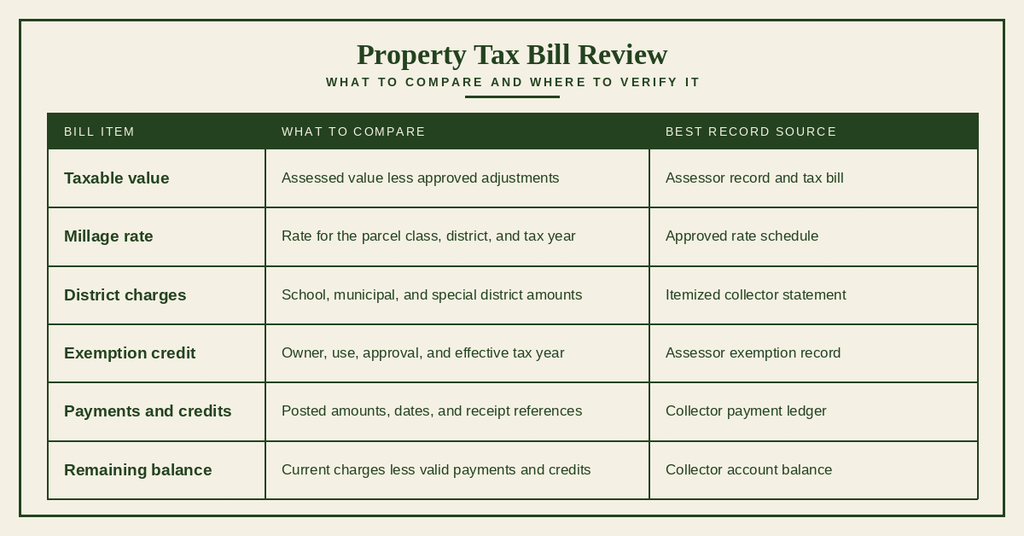
Taxable value is the amount left after valid exemptions and statutory adjustments are applied. The order and method of each adjustment can differ by exemption type, so confirm the credit shown on the tax bill. Compare taxable value with total assessed value before using a millage rate or estimated bill.
Assessment Changes
Compare the current record with earlier tax years to spot changes in land value, improvement value, or total assessed value. A reassessment cycle, sale, permit, appeal, or physical change may affect the result, but the number alone does not reveal the reason. Ask the assessor for a written explanation when the change appears unsupported.
Property Tax Charges
Property tax charges turn a parcel’s taxable value into a bill. One bill can combine county, school, municipal, and special district amounts. Residential property tax statements and commercial property tax records use the same core fields, while a commercial property may have separate buildings, multiple parcels, or other assessment accounts.
Base Property Tax
Base property tax is calculated by multiplying taxable value by the applicable millage rate. A mill equals $1 for every $1,000 of taxable value. Other taxing districts, special assessments, statutory adjustments, credits, and collection fees may appear as separate lines rather than within the base tax.
Taxing District Charges
Taxing district charges cover the millage approved by each public body with taxing authority over the property. A county bill may include school, municipal, and special district millage in addition to the county’s own rate. Read the district name beside each line so you can compare the right authority for that parcel and year.
Special Assessments
A special assessment is a charge tied to a specific service, improvement, or legal purpose rather than the general county millage. The bill or district schedule should identify the assessment and its amount. If the purpose or authority is missing, request the supporting ordinance or notice before treating the charge as verified.
Tax Rates
Tax rates appear as mills per $1,000 of taxable value. Use the rate schedule for the exact tax year, since a parcel can face different rates from prior years and neighboring parcels. A property tax rate calculator needs the taxable value, every applicable millage, and any adjustment shown on the bill.
Total Tax Due
The total tax due combines the base tax, taxing district charges, special assessments, and other lawful charges, then applies credits and adjustments. The amount still owed can differ from the original bill after payments or corrections. Compare the itemized statement with the ledger balance rather than relying on one figure.
Tax Due Dates
The due date printed on the current tax bill controls the payment timetable. South Carolina’s tax year is the calendar year, but yearly due dates and allowed payment periods can change. A past-due date on an old notice does not establish the deadline for a current bill.
Property Tax Payments
A tax bill states what the county charged, while the payment ledger shows what the collector credited. Review both for property tax payment history verification. The same ledger can confirm a tax payment, but it cannot confirm a mortgage balance, loan payoff, or release of a private mortgage lien.
Payment Dates
The ledger date is the date the collector posted or credited the payment. It may differ from the check date, card date, or date you contacted the office. Use the posted date when matching a payment to a tax year and keep the receipt date as a separate field.
Amounts Paid
The amount paid is the sum credited to the tax account after any payment-related adjustment shown in the ledger. A payment may cover one year, several years, or part of a balance. Compare the credited amount with your receipt and check for a separate credit or refund entry.
Payment Status
Common account labels include paid, partial, unpaid, and delinquent. A “paid” status may reflect the full balance after payments and credits rather than a single cash payment. Decode any numeric or abbreviated status against the portal’s current legend or a collector statement.
Partial Payments
A partial payment can reduce the balance while leaving a remaining amount due. Ask the collector which tax year received the payment and whether statutory penalties or collection fees apply to the unpaid portion. Keep a receipt that shows the allocation, since an unmatched lump sum can be difficult to trace later.
Remaining Balance
The remaining balance equals current charges and adjustments minus payments and credits posted to that account. It may include prior-year taxes, interest, penalties, fees, or a payment awaiting posting. Request an itemized balance statement before acting on a figure that differs from your calculation.
Payment History
Payment history should list each tax year, posting date, amount, payment method, receipt or transaction reference, and resulting balance. A returned check, reversed payment, or corrected receipt may appear as a separate entry. For mortgage tax records verification, send the lender the official receipt or ledger statement, not merely a screenshot labeled as paid.
Property Tax Exemptions and Adjustments
Property tax exemption eligibility depends on state law, ownership, occupancy, property use, and the tax year. South Carolina Code of Laws Title 27, Chapter 30 supplies the main tax code references for homestead, senior, disability, agricultural, and veteran exemptions. The assessor confirms qualification, while the Tax Collector applies an approved credit to the bill.
Homestead Exemptions
A qualifying owner-occupied residence may receive a homestead exemption of up to $50,000 of assessed value. The owner must meet state ownership and occupancy rules and file the required application with the assessor. A property label or owner claim does not prove that the exemption is active for the year under review.
Senior Exemptions
State law allows an extra homestead exemption of up to $50,000 for an eligible owner age 65 or older who owns and occupies the residence. S.C. Code § 27-30-210 governs this treatment and its proof requirements. Check each tax year for the credit because age, occupancy, and ownership can affect eligibility.
Disability Exemptions
An eligible owner with a permanent and total disability may qualify for an extra homestead exemption of up to $50,000 under the same chapter. Medical or disability proof forms part of the application. You can also access unclaimed money to review official records. Blind or disabled veterans and certain surviving spouses may have separate treatment, so apply the specific statute rather than the senior rule.
Agricultural Exemptions
Qualifying agricultural real property may receive a 50 percent reduction in fair market value under S.C. Code § 27-30-120. The assessor checks the qualifying use and parcel classification. A rural mailing address, farm name, or separate tax deferment does not by itself prove that the agricultural exemption applies.
Other Eligible Exemptions
S.C. Code § 27-30-70 provides a full assessment exemption for an eligible blind or permanently and totally disabled veteran, or certain surviving spouses, when the property is the first home and does not exceed six acres. Other laws can apply to a particular owner or parcel. Ask the assessor to identify the exact statute and proof on file.
Changes to Exemption Status
An exemption credit should connect to an owner, property, tax year, and approval date. A sale, deed change, occupancy change, age milestone, or certification issue can affect the next year’s status. If the credit is missing, the assessor can state whether the application was denied, filed late, or assigned to another tax year.
Delinquent Property Taxes
A delinquent tax is an unpaid tax charge that remains due after the date stated on the bill and any period allowed by law. The parcel record, collection notice, and tax sale docket serve different purposes. For an unpaid property tax list or real estate tax overdue notice, confirm the parcel, year, amount, and current status in the official record.
Delinquent Tax Status
Delinquent status means the county treats the tax as past due under the applicable collection rules. A current unpaid charge and an old delinquent account may appear together on one parcel. Open each tax year and compare its bill, due date, and ledger before describing the full property as delinquent.
Past-Due Balances
A past-due balance can include the original tax, district charges, adjustments, statutory penalties, interest, collection fees, and prior payments or credits. The oldest unpaid year may carry different costs from the newest year. Request an itemized statement that separates each tax year and charge type.
Penalties and Interest
Penalties, interest, and related fees arise under South Carolina’s tax collection laws and can depend on the event date and payment date. Title 27, Chapter 21 provides the governing collection rules. Use the current collector statement rather than estimating these amounts from an old bill or a generic online formula.
Collection Actions
Collection activity can include a delinquent notice, a tax citation, an execution, or a tax sale process. Read tax citation details for the stated authority, case or citation number, parcel, amount, and response deadline. A citation records collection activity; it does not by itself prove that title or possession changed.
Tax Sale Records
A tax sale record shows a county-led sale process for unpaid taxes under Title 12, Chapter 49. A tax deed auction listing does not prove that a deed was transferred or that the buyer received clear title. Confirm the final sale result, court action, and recorded disposition with the official case and land records.
Tax Foreclosure
Mortgage foreclosure is a lender and court process involving a private mortgage. A tax sale and a mortgage foreclosure are separate events, even though both may affect property ownership. Property tax records can show tax delinquency, but they do not prove a mortgage default, payoff amount, or foreclosure sale.
Historical Property Tax Records
A real estate tax history search places several tax years side by side so changes in value, exemptions, charges, and payment can be traced. Historical records support due diligence, closing reviews, and property tax payment history verification. They also help separate a current balance from taxes that were already paid.
Previous Tax Years
Previous tax years show the parcel’s assessment and collection history before the current billing cycle. The online portal may expose only certain years, so older statements may require archived records or a collector request. Match each year to its bill rather than treating all prior taxes as one balance.
Historical Tax Amounts
Historical tax amounts can mean the original billed total, the adjusted total, the amount paid, or the amount left unpaid. Compare the itemized bill with the payment ledger to identify which figure applies. An adjusted bill or refund may differ from the first notice issued for that year.
Historical Property Values
Past records can show changes in land value, improvement value, total assessed value, and taxable value. A higher assessed value does not always produce a proportionately higher bill because rates, exemptions, and district charges can also change. Compare each year’s complete statement before drawing a trend.
Past Payment Records
Historic property tax payments should match a year, posted date, amount, receipt reference, and ledger status. A check that was mailed but never cleared will not appear as a completed payment. Request the receipt or collector ledger if a payment is missing from the portal.
Changes in Tax Liability
A change in tax liability can come from a new assessment, a different millage, a district change, an exemption change, a special assessment, penalties, or an unpaid balance carried forward. Review the year-over-year worksheet before assigning the change to property appreciation alone.
Property Tax Record Verification and Corrections
Verified tax records separate the assessor’s valuation work from the Tax Collector’s billing and payment work. The assessor handles assessed values, property classes, and exemptions. The Tax Collector handles rates, charges, receipts, credits, and account balances. Sending a question to the correct office saves time and keeps the correction attached to the right record.
Confirming the Tax Account
Confirm the parcel number, legal owner, situs address, account number, and tax year before treating a record as yours. Ownership and mailing records can update at different times after a sale. A name-only match is weaker evidence than a parcel and account match.
Checking the Tax Year
Check the year on the bill, assessment notice, tax map, and collector statement. A tax notice explanation should align the owner, parcel, assessed value, taxable value, exemption, due date, and appeal deadline. Mixed years often create a false balance or an incorrect appeal deadline.
Reviewing Property Values
Compare the county’s land and improvement assessments with recorded facts such as the deed, building permits, and recent sales. A property tax appraisal report may provide the county’s stated basis for value, while a private appraisal may use a different scope or date. Neither private value nor a broker estimate overwrites the official record.
Verifying Tax Charges
Verify each charge against the bill, the applicable millage schedule, and the authority named for the charge. Check that the parcel class and taxing districts match the property. Special assessments need their own source because they do not appear in the general millage calculation.
Checking Payment Entries
Match each payment entry to its receipt, posted date, amount, method, and tax year. Look for credits, reversals, and transfers that can change the balance even when the gross payment amount matches. An official receipt or itemized collector statement provides stronger proof than a portal note.
Correcting Record Errors
Send assessment-value and exemption questions to the assessor with the parcel number and supporting documents. Send billing, payment, credit, and refund questions to the Tax Collector with receipts and a clear calculation. Keep a copy of every submission and note the employee, date, and case or reference number.
Assessment corrections
Include records that support the requested change, such as a deed, survey, permit, or proof of an eligible exemption. Ask the assessor to identify the field that needs correction and the effective tax year. A corrected assessment may lead to a revised bill or credit, depending on the record and payment date.
Payment and refund requests
For an overpayment, send the receipt, parcel number, tax year, amount paid, and the proposed refund calculation to the Tax Collector. S.C. Code § 27-7-310 sets a three-year claim period for refunds of taxes paid above the amount due. Act within that period and keep proof of the claim.
Assessment appeals
A written assessment appeal generally must be filed with the county assessor within 90 days after the assessment notice under S.C. Code § 27-11-32. State law also provides later review through the court process, with separate deadlines. Read the notice for the current filing instructions and use the appeal process for value or exemption issues, not for a missing payment receipt.
Search Problems
Most search problems come from a mismatched identifier, an older tax year, or a payment that has not posted. Work from the parcel number whenever possible, save the exact search terms, and record the date of each attempt. A clear trail of sources supports faster correction by the county office.
Property Not Found
Try the parcel or map number from a tax document, then search by the current situs address without apartment or unit punctuation. Check whether the property sits in a nearby county or a municipal jurisdiction with a separate portal. If an address search still fails, request a parcel-number lookup from the Greenville County Assessor.
Owner Name Does Not Match
An owner-name mismatch can result from a recent deed, an entity name, a trustee, a spouse, or a record that has not yet reflected a transfer. Search by parcel number to confirm the property. If the parcel shows a different owner, request the current deed record rather than assuming the portal entry is wrong.
Incorrect Account or Parcel Number
Copy the parcel number directly from the bill, notice, deed, or prior county record. A tax account number and map number may have different formats, so do not swap them or remove leading zeros without checking. Compare the situs address after the search to catch a transposed digit.
Tax Year Not Available
Older tax years may sit outside the portal’s online archive or may require a different record series. Search the current parcel, then ask the Tax Collector for an archived statement for the missing year. A missing year does not mean the tax was never billed or paid.
Missing Payment Information
A missing payment can reflect a posting delay, returned check, reversed transaction, or transfer to another account. Check the transaction history and the payment method, then compare the receipt number with the collector’s ledger. Bring the receipt to the Tax Collector if the portal still lacks the entry.
Unexpected Tax Balance
Request an itemized statement that separates current-year charges, prior-year balances, adjustments, penalties, interest, credits, and payments. Check whether the portal combines unpaid tax years on one account. A prior-year amount can look like a current bill when the year field is hidden or easy to miss.
Recently Updated Record
A recent update can reflect a new assessment, payment posting, exemption change, owner transfer, or ledger correction. Save the current result with its date and time, then compare it with an earlier copy. If the update changes a closing, lending, or dispute decision, request the county’s written record showing which field changed.
Contact Details
For a parcel-specific request, provide the parcel number, tax year, and record type when you contact the county.
- Contact: Greenville County Assessor and Tax Collector
- Address: 301 University Ridge, Suite S-1000, Greenville, SC 29601
- Phone: (864) 467-7300
- Office Hours: Mon-Fri: 8:30 AM – 5:00 PM
Frequently Asked Questions
Answers below cover common ways to locate and use Property Tax Records in Greenville County, including online searches, bill downloads, and lien checks.
How can I find property tax records online?
Visit the Greenville County tax collector portal at the official website link. Enter the parcel number or address in the search field. The system returns the tax roll database entry, showing taxable value, assessment year, and payment status. Results can be filtered by year or tax type. If you need help, call the office at (864) 467-7300 during business hours. Printed copies are available for pickup at the office located at 301 University Ridge, Suite S-1000.
What info appears on a tax assessment lookup?
A tax assessment lookup displays the parcel number, land and improvement values, and the taxable amount set by the assessor. It also lists the current tax rate, any exemptions applied, and the total tax due for the year. Payment history for previous years may be shown, along with any outstanding balances. The page often includes a link to download the detailed appraisal report. Contact the assessors office if any figures seem incorrect.
Where to view unpaid property tax list for Greenville?
Unpaid property tax lists are accessible through the county tax collector’s online portal. Select the “Delinquent Taxes” section and enter the desired year or filter by neighborhood. The list shows parcel numbers, owner names, amount owed, and due dates. You can print or export the data for review. For specific questions, reach the collector’s staff by phone. They can confirm if a property appears on the current unpaid list.
How do I download a property tax bill for a parcel?
Log in to the public records site and type the parcel number in the search bar. After the record loads, choose the “Tax Bill” option for the desired tax year. A PDF file will generate, showing the bill amount, due date, and payment instructions. Save the file to your device or print it directly. If the bill does not appear, verify the parcel number or contact the tax office for assistance.
Can I check tax lien status by address?
Yes, the county tax collector database includes a lien search feature. Enter the property address in the search field labeled “Lien Search.” The result page indicates whether a lien exists, the filing date, and the amount claimed. Details on how to resolve the lien are also provided. For further clarification, call the collector’s office during regular hours. They can guide you through the steps to clear any recorded liens.